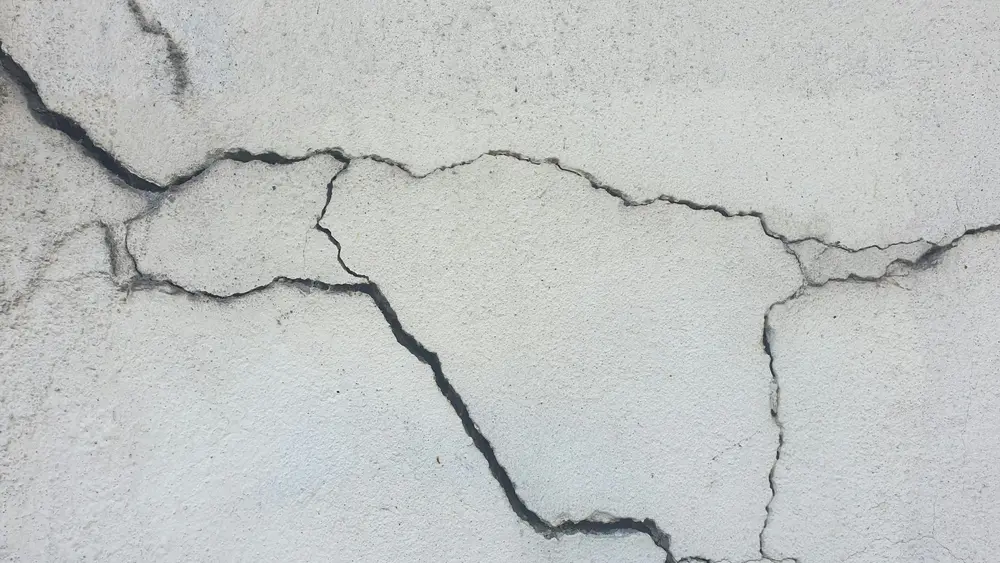
Why poured walls crack
Concrete shrinks as it cures, and a foundation wall is long, thin and restrained at the footing. It cracks — usually vertical or slightly diagonal, often below a window or near a corner, and often within the first year. On its own the crack is not a structural problem. It is a path for water, and on the Lake Simcoe side of town the ground outside that path is wet for much of the year.
What injection does
Surface ports are fixed along the crack every 20–30 cm. The face of the crack between the ports is sealed with a fast-curing paste. Low-pressure polyurethane resin is injected through the lowest port until it appears at the next one, then the next, working up the wall. The resin reacts with the water in the crack, expands, and fills it from the inside face to the soil face. Once cured, the ports are cut off and the paste is ground back.
What we check first
- Is the wall poured concrete? Injection does not work on block.
- Is the crack wider than about 6 mm, stepped, or wider at the top than the bottom? That is movement, and it goes to an engineer before us.
- Is there more than one? Several cracks on one wall with a wet floor along it point to a drain problem, not a crack problem.
- Is there a tie hole or a pipe penetration leaking nearby that looks like a crack? Those are sealed differently.
Afterwards
The wall can be finished the next day. If the crack was leaking under a finished wall, the drywall that came out to reach it is the only thing to put back.